
Warehouse ventilation
The importance of ventilation in warehouses
Adequate ventilation is essential to protect workers’ health and safety and to provide a reasonable level of comfort so they can work in the right conditions
Therefore, the higher the occupancy, the more important it is to control ventilation
Good planning of air circulation avoids problems and provides a suitable working environment
Benefits of ventilation
in warehouses
They provide efficient airflow, improve working conditions, reduce energy consumption and require minimal maintenance.
It provides a cooler, more comfortable environment, reducing heat stress and improving employee performance.
It disperses gases, vapours and dust, minimising fire risks and respiratory problems among workers.
It prevents moisture build-up and controls temperature, avoiding damage to sensitive products such as electronics or food.
It improves air quality, reduces humidity and prevents respiratory problems, creating a healthier environment.
It reduces the use of costly cooling systems, lowering energy consumption and maintenance costs.
More posts
Cool,
ventilated spaces
with quality air...
Under ideal conditions, Lfans HVLS fans can achieve temperature drops of up to 6 ºC
As the graph shows, an air current with a speed of 2.5 m/s (10 km/h) at an ambient temperature of 31 ºC produces a perceived temperature of 26.5 ºC

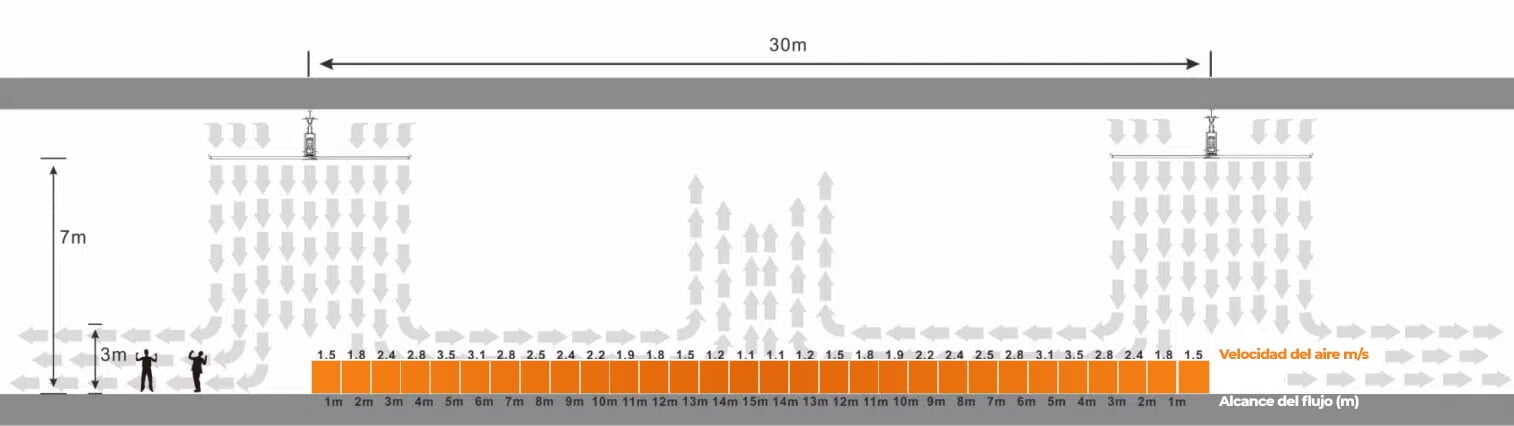
Ask our engineering team how much the perceived temperature would drop in your facility
Benefits of ventilation
The importance of ventilation goes beyond removing heat from a warehouse without air conditioning or removing odours and humidity in a manufacturing plant. Although these are perhaps its most common applications, ventilation goes far beyond simple extraction. For example, a direct link has been shown between employee productivity and health and the level of ventilation in a work area.
Adequate ventilation has been shown to help…
Performance
Increase worker performance
Health
Create healthier, more comfortable spaces
Risk reduction
Reduce the risk of disease transmission if someone who could spread an infection is present in an enclosed space


