

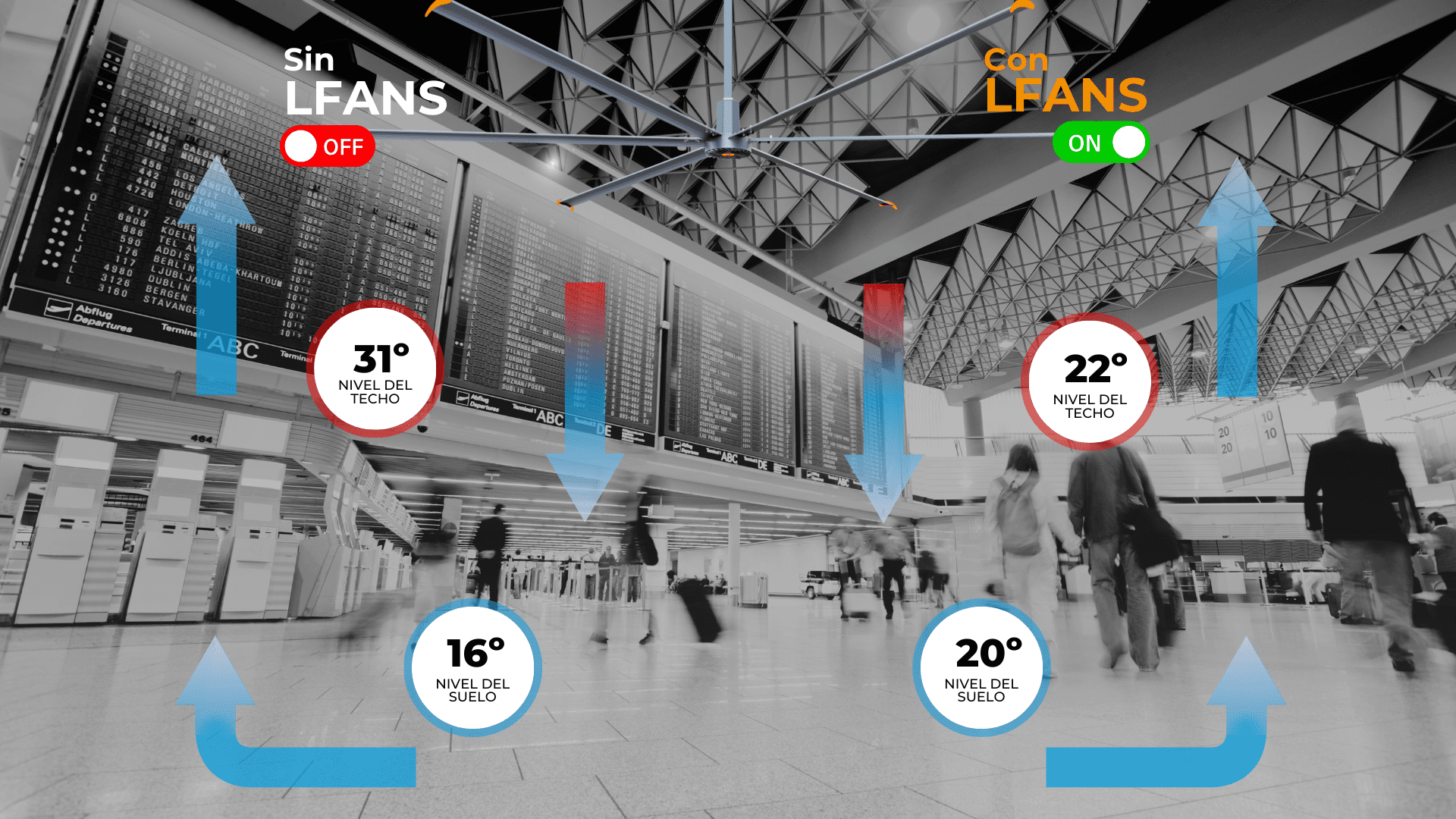
When heat is introduced into a space, temperature layers or strata form. The warmest air rises and accumulates in the upper layers of the space, while the cold air stays at floor level, where people work.
This is because air heated by a forced-air system (HVAC) is between 5% and 10% lighter than air at desirable room temperatures (18 ºC to 24 ºC).
Heated air naturally rises to the highest point, where temperatures can reach 29 ºC to 52 ºC depending on the characteristics of the structure and the ceiling height.
The thermostat, which is usually at floor level, records the temperature of the coldest air, telling the forced-air system to keep working to reach the desired temperature, with the resulting extra cost.
Lfans HVLS fans create a natural air circulation, preventing warm air from building up at the ceiling and cold air at floor level, breaking up those strata and creating a single layer in which the temperature is uniform, with the resulting energy savings for the forced-air system.
Diameter: 7.3 metres
Motor: 1.1 kW
Rotation speed: 55 rpm
Air flow: 13,000 m³/min
Coverage: 1,800 m2
Power supply: 220 V
Magnetic motor weight: 36 kg
Blade weight: 107 kg
Noise level: 38 dB
Diameter: 5 metres
Motor: 0.75 kW
Rotation speed: 80 rpm
Air flow: 11,000 m³/min
Coverage: 1,200 m2
Power supply: 220 V
Magnetic motor weight: 22 kg
Blade weight: 62 kg
Noise level: 38 dB